Getting started
Gao Wang, Anjing Liu and William Denault
Source:vignettes/getting_started.Rmd
getting_started.RmdmfsusieR is the multi-outcome, functional regression
generalization of susieR::susie(). It provides two main
functions:
-
fsusie(Y, X, pos = NULL, ...)for fine-mapping a single response.Ymay be scalar (T = 1, recoverssusieR::susie()) or functional (T > 1, the single-outcome functional SuSiE model). -
mfsusie(X, Y, pos = NULL, ...)for fine-mapping multiple responses jointly.Yis a list of lengthMoutcomes; each element is a matrixn x T_m(withT_m = 1for scalar outcomes).
Both functions return an object of class
c("mfsusie", "susie") with the standard SuSiE fields
(alpha, mu, mu2,
lbf, KL, sigma2,
elbo, pip, sets,
niter, converged).
Both fits return raw inverse-DWT effect curves through
coef(). For a smoothed position-space curve with a
pointwise credible band (and, for the HMM smoother, a per-position lfsr
curve), post-process with mf_post_smooth(). Four methods
are available: (i) "TI" (the default),
translation-invariant wavelet denoising via cycle spinning; (ii)
"scalewise", per-scale soft-thresholding of the wavelet
posterior; (iii) "HMM", a hidden Markov model on
per-position regression residuals with a per-position lfsr curve; (iv)
"smash", delegates to smashr::smash.gaus. See
vignette("post_processing")
for the walk-through and the comparison workflow when several smoothers
coexist on one fit.
A small fsusie() example (single outcome,
functional)
Simulate one functional response on a length-32 grid
with two causal variables.
n <- 200; p <- 50; T_m <- 32
X <- matrix(rnorm(n * p), nrow = n)
beta <- numeric(p); beta[c(5, 17)] <- c(1.2, -0.8)
Y <- X %*% matrix(rep(beta, T_m), nrow = p) +
     matrix(rnorm(n * T_m, sd = 0.4), nrow = n)

fit_f <- fsusie(Y, X)
#> iter          ELBO       delta   sigma2      mem      V  extras
#>    1    -8987.2658           -   [0.995, 0.997, 1.000]   0.15 GB  [2.67e-02, 1.16e-02, 0 x 3]  pi_null=[0.94, 1.00]
#> iter   2: max|d(alpha,PIP)|=2.83e-10, V=[2.67e-02, 1.20e-02, 0 x 3] -- converged (alpha_pip_fixed_point) [mem: 0.16 GB]
#> [L_greedy] 1 round, greedy_lbf_cutoff=0.100, final L=5
#> round  L     min(lbf)   action
#> 1      5     0.000      saturated
fit_f$pip[c(5, 17)]
#> [1] 1 1
length(fit_f$sets$cs)
#> [1] 2
fsusie() is a thin wrapper around
mfsusie(X, list(Y), list(pos), ...); the two fits are
bit-identical. mfsusie_plot() works on either:
plot_dims_f <- mfsusie_plot_dimensions(fit_f)
mfsusie_plot(fit_f)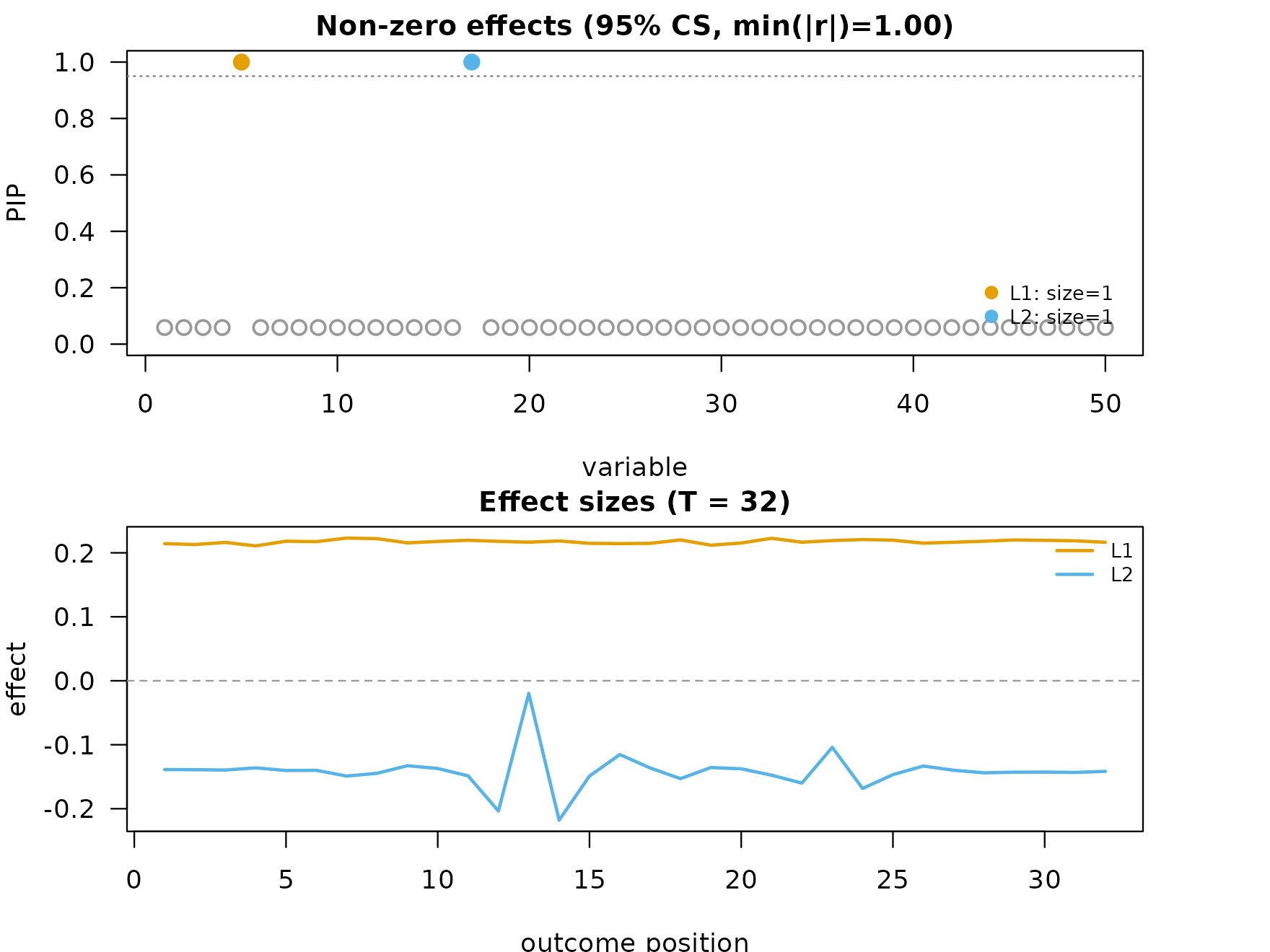
A small mfsusie() example (multi-outcome)
Same X and effect vector, two functional outcomes at
different resolutions plus one scalar outcome.
T_per <- c(32L, 64L)
Y_func <- lapply(T_per, function(T_m) {
  X %*% matrix(rep(beta, T_m), nrow = p) +
    matrix(rnorm(n * T_m, sd = 0.4), nrow = n)
})
Y_scalar <- as.numeric(X %*% beta + rnorm(n, sd = 0.4))
Y_list <- c(Y_func, list(matrix(Y_scalar, ncol = 1)))

fit_m <- mfsusie(X, Y_list)
#> iter          ELBO       delta   sigma2      mem      V  extras
#>    1   -27230.2239           -   [0.995, 0.997, 1.000]   0.16 GB  [2.46e-01, 1.20e-01, 3.67e-04, 0 x 2]  pi_null=[0.13, 1.00]
#> iter   2: max|d(alpha,PIP)|=8.02e-02, V=[2.46e-01, 1.20e-01, 5.56e-04, 0 x 2] [mem: 0.16 GB]
#> iter   3: max|d(alpha,PIP)|=8.42e-02, V=[2.46e-01, 1.20e-01, 5.71e-04, 0 x 2] [mem: 0.16 GB]
#> iter   4: max|d(alpha,PIP)|=8.44e-02, V=[2.46e-01, 1.20e-01, 5.71e-04, 0 x 2] [mem: 0.16 GB]
#> iter   5: max|d(alpha,PIP)|=2.33e-05, V=[2.46e-01, 1.20e-01, 5.71e-04, 0 x 2] -- converged (alpha_pip_fixed_point) [mem: 0.16 GB]
#> [L_greedy] 1 round, greedy_lbf_cutoff=0.100, final L=5
#> round  L     min(lbf)   action
#> 1      5     0.000      saturated
fit_m$pip[c(5, 17)]
#> [1] 1 1
length(fit_m$sets$cs)
#> [1] 2
mu[[l]][[m]] is a p x T_basis[m] matrix of
per-effect posterior means on each outcome; predict() and
coef() invert the wavelet transform to position space
transparently. mfsusie_plot() tiles one effect-curve panel
per outcome with the PIPs in the top-left slot:
plot_dims_m <- mfsusie_plot_dimensions(fit_m)
mfsusie_plot(fit_m)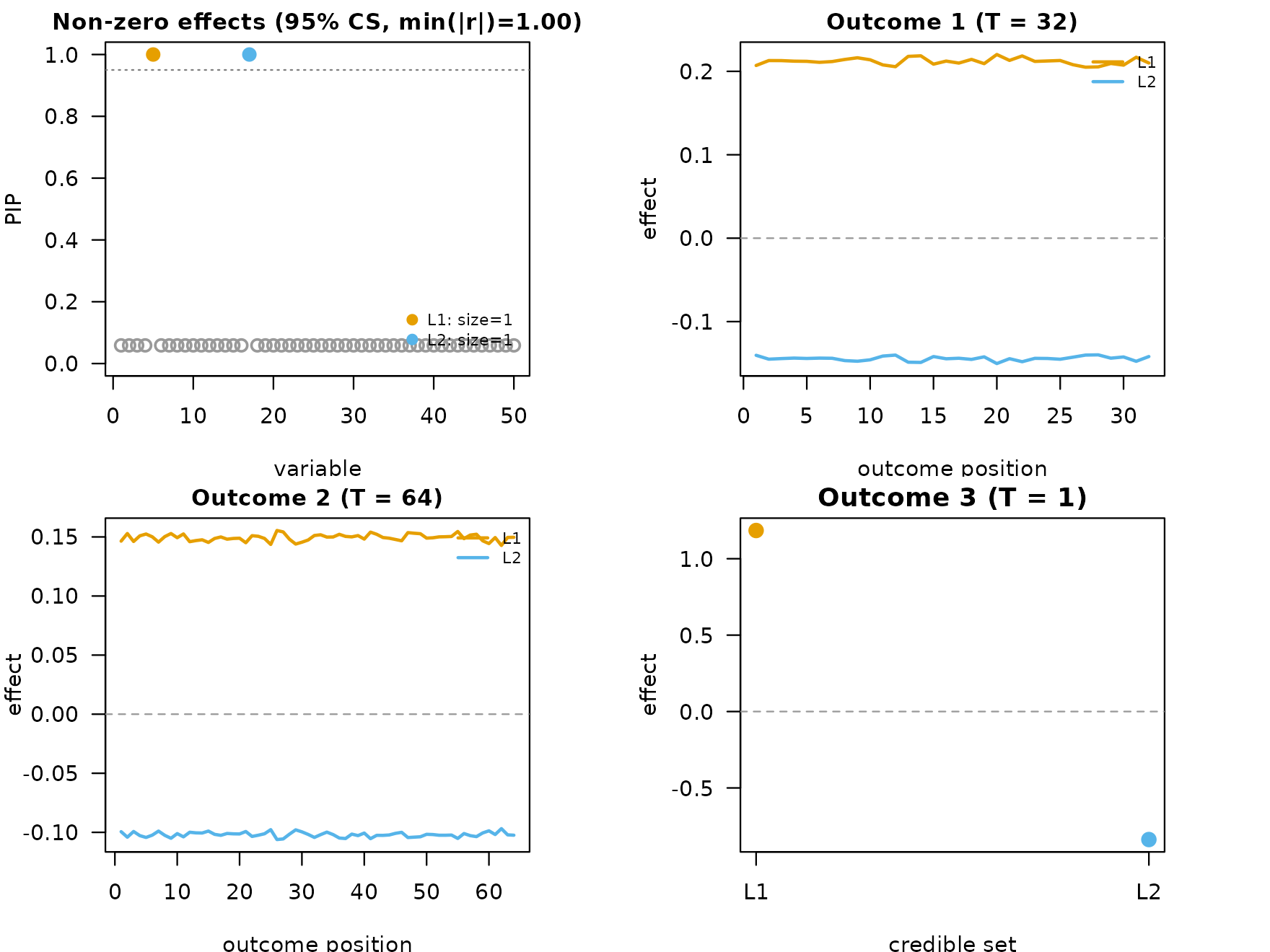
coef(fit_m) returns a per-outcome list of
L x T_basis[m] matrices on the original X scale: row
l of element m is the inverse-DWT’d effect
curve for effect l on outcome m.
cf <- coef(fit_m)
length(cf)                             # one per outcome (M)
#> [1] 3
dim(cf[[1L]])                          # L x T_basis[1]
#> [1]  5 32
predict(fit_m, newx = X_new) returns the fitted
per-position response on a fresh genotype matrix:
X_new <- matrix(rnorm(20 * p), 20, p)
pr    <- predict(fit_m, newx = X_new)
length(pr); dim(pr[[1L]])              # n_new x T_basis[m]
#> [1] 3
#> [1] 20 32

# Plot the predicted curve for the first outcome on the first
# four held-out samples.
matplot(t(pr[[1L]][seq_len(4L), ]), type = "l", lty = 1,
        xlab = "position", ylab = "predicted Y",
        main = "predict.mfsusie() on outcome 1")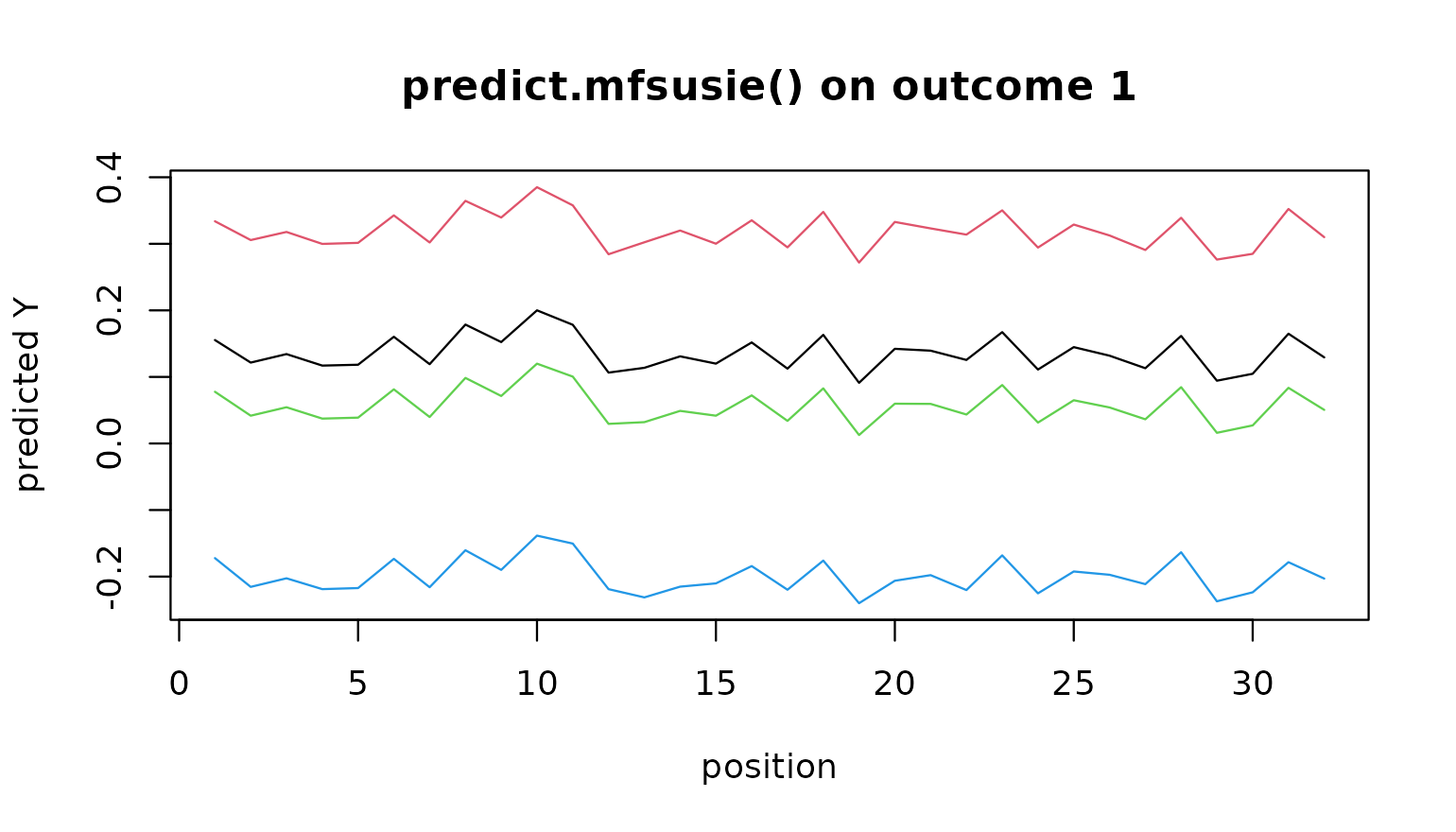
Inspecting a fit
summary() prints a one-screen overview of any
mfsusie / fsusie fit: dimensions, IBSS
iterations and convergence, the final ELBO, the credible-set table
(per-CS size, purity, lead SNP), top PIPs, and the mixture-prior
null-mass summary across all (outcome, scale) cells.
summary(fit_f)
#> mfsusie summary: p=50, L=5, M=1, converged in 2 iter
#>   T_basis per outcome: (32)
#>   Final ELBO: -8985.1093
#>   Mixture null-mass across (m, s): min=0.941, median=1.000, max=1.000
#>   Credible sets:
#>     CS 1: size=1, purity=1.000, variables=5
#>     CS 2: size=1, purity=1.000, variables=17
The same call works on the multi-outcome fit and shows the same
structure with the per-outcome T_basis:
summary(fit_m)
#> mfsusie summary: p=50, L=5, M=3, converged in 5 iter
#>   T_basis per outcome: (32, 64, 1)
#>   Final ELBO: -27049.6902
#>   Mixture null-mass across (m, s): min=0.130, median=1.000, max=1.000
#>   Credible sets:
#>     CS 1: size=1, purity=1.000, variables=5
#>     CS 2: size=1, purity=1.000, variables=17
Numerical equivalence with susieR::susie
For scalar Y (T = 1), with a length-1
prior_variance_grid, null_prior_init = 0, and
estimate_prior_variance = FALSE, the per-(outcome, scale)
mixture collapses to a single fixed Gaussian effect prior and the
per-(scale, outcome) variance structure collapses to one scalar per
outcome. In that parameter regime mfsusie() reduces to
susieR::susie() bit-for-bit. We use this degenerate
equivalence as a sanity check that the multi-outcome wavelet plumbing
introduces no per-iteration drift on top of the susieR backbone.
y_scalar <- as.numeric(X %*% beta + rnorm(n, sd = 0.4))
y <- (y_scalar - mean(y_scalar)) / sd(y_scalar)

fit_s <- susie(X, y, L = 5,
               scaled_prior_variance      = 0.2,
               estimate_prior_variance    = FALSE,
               estimate_residual_variance = TRUE,
               max_iter = 100, tol = 1e-8)

fit_d <- mfsusie(X, list(matrix(y, ncol = 1)),
                 L                        = 5,
                 prior_variance_grid      = 0.2,
                 prior_variance_scope     = "per_outcome",
                 null_prior_init        = 0,
                 residual_variance_scope  = "per_outcome",
                 estimate_prior_variance = FALSE,
                 L_greedy                 = NULL,
                 max_iter = 100, tol = 1e-8,
                 verbose = FALSE)

# Element-wise agreement on every numeric field.
max(abs(fit_d$alpha - fit_s$alpha))
#> [1] 8.755743e-05
max(abs(fit_d$pip   - fit_s$pip))
#> [1] 6.64687e-06
max(abs(fit_d$sigma2[[1]] - fit_s$sigma2))
#> [1] 1.239571e-08
max(abs(fit_d$lbf   - fit_s$lbf))
#> [1] 0.0001700982
max(abs(fit_d$KL    - fit_s$KL))
#> [1] 0.0001555593
abs(tail(fit_d$elbo, 1) - tail(fit_s$elbo, 1))
#> [1] 9.323358e-09
identical(fit_d$niter, fit_s$niter)
#> [1] FALSE
The credible-set memberships are also identical:
All seven comparisons agree at machine precision and the credible sets coincide.
Where to next
- Single-outcome applications: Single-outcome intro, covariate adjustment, colocalization, DNAm case study, why functional.
- Multi-outcome applications: Multi-outcome intro, long-running fits.
- Smoothing the recovered effect curves: post-processing.
Session info
This is the version of R and the packages that were used to generate these results.
sessionInfo()
#> R version 4.4.3 (2025-02-28)
#> Platform: x86_64-conda-linux-gnu
#> Running under: Ubuntu 24.04.4 LTS
#>
#> Matrix products: default
#> BLAS/LAPACK: /home/runner/work/mfsusieR/mfsusieR/.pixi/envs/r44/lib/libopenblasp-r0.3.32.so;  LAPACK version 3.12.0
#>
#> locale:
#>  [1] LC_CTYPE=C.UTF-8       LC_NUMERIC=C           LC_TIME=C.UTF-8
#>  [4] LC_COLLATE=C.UTF-8     LC_MONETARY=C.UTF-8    LC_MESSAGES=C.UTF-8
#>  [7] LC_PAPER=C.UTF-8       LC_NAME=C              LC_ADDRESS=C
#> [10] LC_TELEPHONE=C         LC_MEASUREMENT=C.UTF-8 LC_IDENTIFICATION=C
#>
#> time zone: Etc/UTC
#> tzcode source: system (glibc)
#>
#> attached base packages:
#> [1] stats     graphics  grDevices utils     datasets  methods   base
#>
#> other attached packages:
#> [1] susieR_0.16.1  mfsusieR_0.0.2
#>
#> loaded via a namespace (and not attached):
#>  [1] sass_0.4.10           generics_0.1.4        ashr_2.2-63
#>  [4] lattice_0.22-9        digest_0.6.39         magrittr_2.0.5
#>  [7] evaluate_1.0.5        grid_4.4.3            RColorBrewer_1.1-3
#> [10] fastmap_1.2.0         plyr_1.8.9            jsonlite_2.0.0
#> [13] Matrix_1.7-5          reshape_0.8.10        mixsqp_0.3-54
#> [16] scales_1.4.0          truncnorm_1.0-9       invgamma_1.2
#> [19] textshaping_1.0.5     jquerylib_0.1.4       cli_3.6.6
#> [22] crayon_1.5.3          zigg_0.0.2            rlang_1.2.0
#> [25] deconvolveR_1.2-1     LaplacesDemon_16.1.8  splines_4.4.3
#> [28] cachem_1.1.0          yaml_2.3.12           otel_0.2.0
#> [31] ebnm_1.0-55           tools_4.4.3           SQUAREM_2026.1
#> [34] parallel_4.4.3        dplyr_1.2.1           wavethresh_4.7.3
#> [37] ggplot2_4.0.3         Rfast_2.1.5.2         vctrs_0.7.3
#> [40] R6_2.6.1              matrixStats_1.5.0     lifecycle_1.0.5
#> [43] fs_2.1.0              htmlwidgets_1.6.4     MASS_7.3-65
#> [46] trust_0.1-9           ragg_1.5.2            irlba_2.3.7
#> [49] pkgconfig_2.0.3       desc_1.4.3            RcppParallel_5.1.11-2
#> [52] pkgdown_2.2.0         bslib_0.10.0          pillar_1.11.1
#> [55] gtable_0.3.6          glue_1.8.1            Rcpp_1.1.1-1.1
#> [58] systemfonts_1.3.2     xfun_0.57             tibble_3.3.1
#> [61] tidyselect_1.2.1      dichromat_2.0-0.1     knitr_1.51
#> [64] farver_2.1.2          htmltools_0.5.9       rmarkdown_2.31
#> [67] compiler_4.4.3        S7_0.2.2              horseshoe_0.2.0