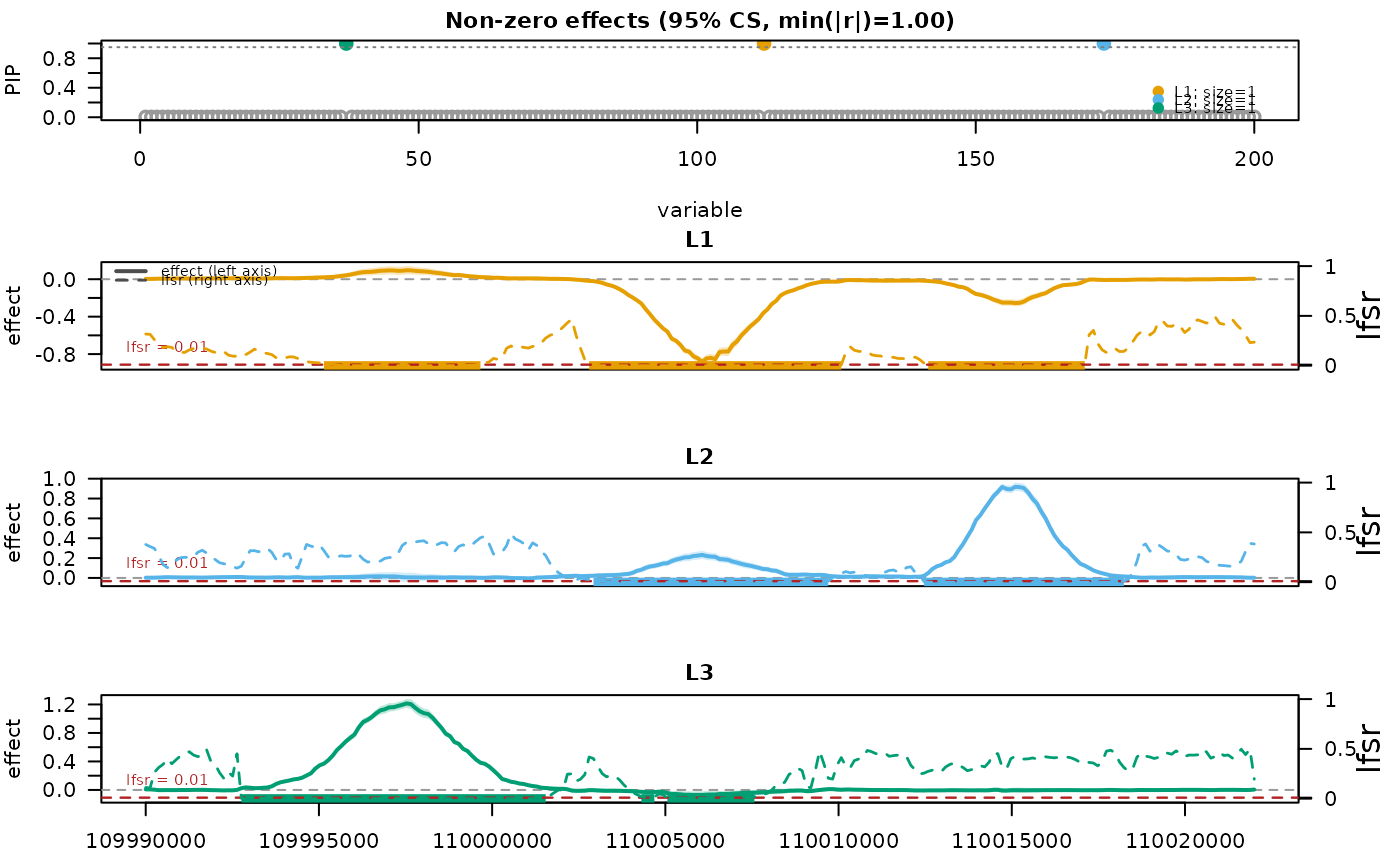
Simulated cis-eQTL data inspired by published GTEx case
studies (AHCYL1, SCD, HSP90AA1, STMN2, ABHD17A): a
functional response on 256 gene-body positions, three
causal SNPs with localized peak effects at distinct 5',
mid-body, and 3' positions. Used by
vignette("fsusie_gtex_case_study").
Format
A list with components
Xn x pgenotype matrix (p = 200) sliced fromsusieR::N3finemapping$X.Yn x Tlog1p-coverage matrix (T = 256).poslength-
Tinteger vector of gene-body positions.causal_snpsinteger vector of column indices in
Xthat carry true effects.causal_betaslength(causal_snps) x Tmatrix of true per-position effects.descriptionfree-text description.
Examples
# \donttest{
data(gtex_example)
fit <- fsusie(gtex_example$Y, gtex_example$X,
pos = gtex_example$pos, L = 15, L_greedy = 5,
verbose = TRUE)
#> HINT: ncol(Y) is not 2^J or positions are unevenly spaced; interpolated to a regular dyadic grid.
#> iter ELBO delta sigma2 mem V extras
#> 1 -205841.8728 - [0.998, 0.998, 1.000] 0.20 GB [1.75e-02, 1.16e-02, 9.48e-03, 1.01e-03, 0 x 1] pi_null=[0.92, 1.00]
#> iter 2: max|d(alpha,PIP)|=1.60e-01, V=[1.63e-02, 1.50e-02, 9.98e-03, 1.38e-03, 0 x 1] [mem: 0.20 GB]
#> iter 3: max|d(alpha,PIP)|=1.70e-01, V=[1.61e-02, 1.51e-02, 9.99e-03, 1.33e-03, 0 x 1] [mem: 0.20 GB]
#> iter 4: max|d(alpha,PIP)|=1.65e-01, V=[1.60e-02, 1.51e-02, 1.00e-02, 1.22e-03, 0 x 1] [mem: 0.20 GB]
#> iter 5: max|d(alpha,PIP)|=1.56e-01, V=[1.58e-02, 1.51e-02, 1.00e-02, 1.13e-03, 0 x 1] [mem: 0.20 GB]
#> iter 6: max|d(alpha,PIP)|=1.46e-01, V=[1.57e-02, 1.51e-02, 1.00e-02, 1.05e-03, 0 x 1] [mem: 0.20 GB]
#> iter 7: max|d(alpha,PIP)|=3.00e-02, V=[1.56e-02, 1.51e-02, 1.00e-02, 9.84e-04, 0 x 1] [mem: 0.20 GB]
#> iter 8: max|d(alpha,PIP)|=8.12e-02, V=[1.53e-02, 1.51e-02, 1.00e-02, 9.47e-04, 0 x 1] [mem: 0.20 GB]
#> iter 9: max|d(alpha,PIP)|=8.00e-02, V=[1.45e-02, 1.51e-02, 1.00e-02, 7.18e-04, 0 x 1] [mem: 0.20 GB]
#> iter 10: max|d(alpha,PIP)|=7.13e-02, V=[1.40e-02, 1.51e-02, 1.00e-02, 7.15e-04, 0 x 1] [mem: 0.20 GB]
#> iter 11: max|d(alpha,PIP)|=1.86e-05, V=[1.40e-02, 1.51e-02, 1.00e-02, 7.15e-04, 0 x 1] -- converged (alpha_pip_fixed_point) [mem: 0.20 GB]
#> [L_greedy] 1 round, greedy_lbf_cutoff=0.100, final L=5
#> round L min(lbf) action
#> 1 5 0.000 saturated
fit_s <- mf_post_smooth(fit, method = "TI")
mfsusie_plot(fit_s)
 # }
# }